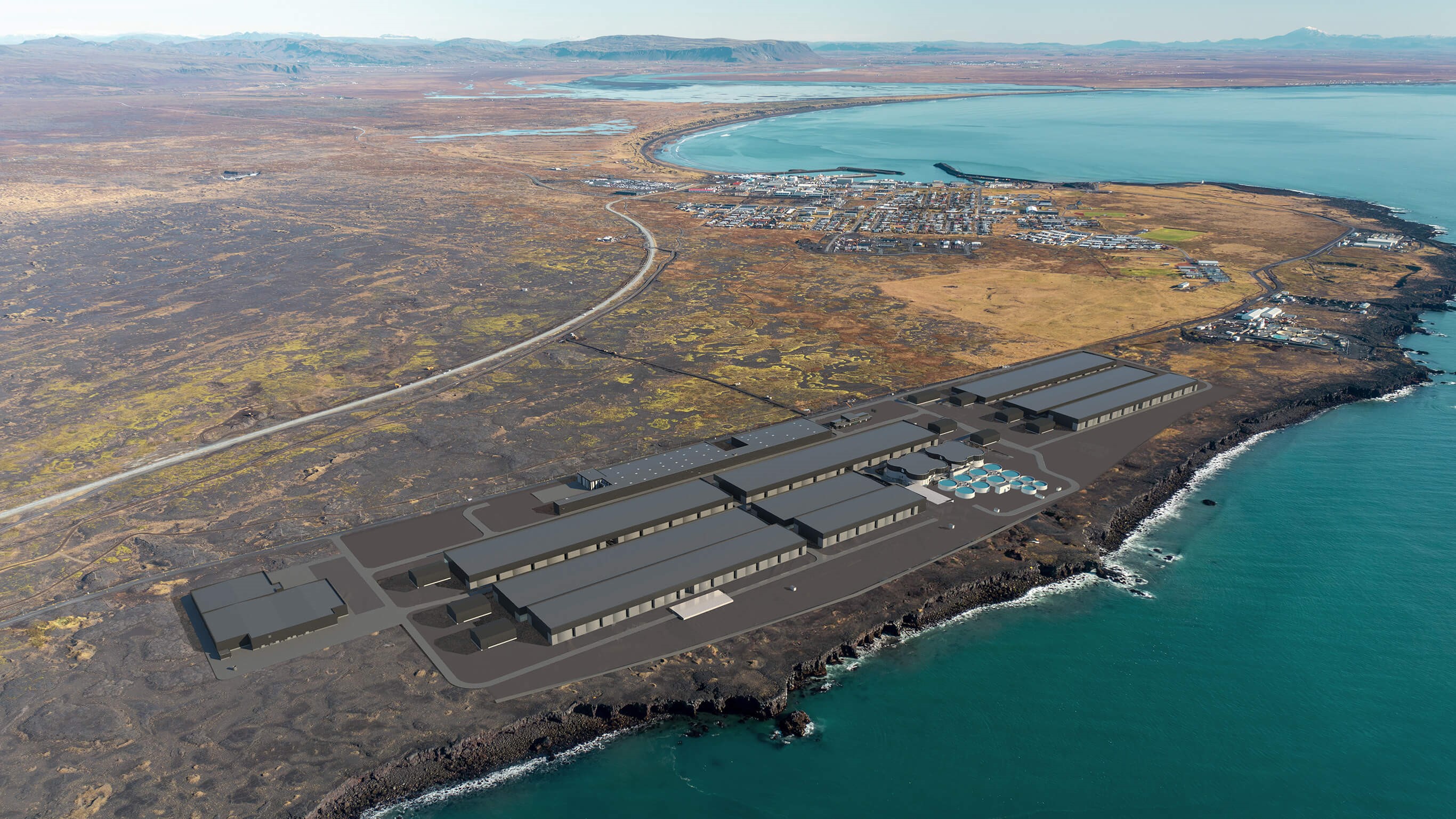
Icelandic land-based salmon farming company, constructing a large-scale fish farm for Atlantic salmon in Þorlákshöfn. Acquired 52 hectares of land, 3 km west of Þorlákshöfn. In addition, acquired an up-and-running hatchery Öxnalækur in 2020. Plans for 73,000 tonnes (60,000 HOG) annual production in 6 phases with full capacity at the end of 2031.

The location in Þorlákshöfn offers access to vital sustainable resources for the operation in both quantity and quality, namely seawater and electricity. Unique conditions where an underground porous lava bed provides naturally filtered seawater at constant temperature. Strategic location close to shipping harbour & international airport enables direct and fast access to major markets in Europe and USA.
The company was founded by group of passionate entrepreneurs with diverse and comprehensive experience. The company has successfully completed an impact assessment, obtained approval from the Ölfus municipality authorities, and acquired both land and hatchery facilities, which are currently operational.
Hatchery in Öxnalækur is a flow through site and has been in operation + 20 years and was redesigned in 2019. Will support phase 1 - 2 until the new RAS hatchery in Laxabraut is up and running.
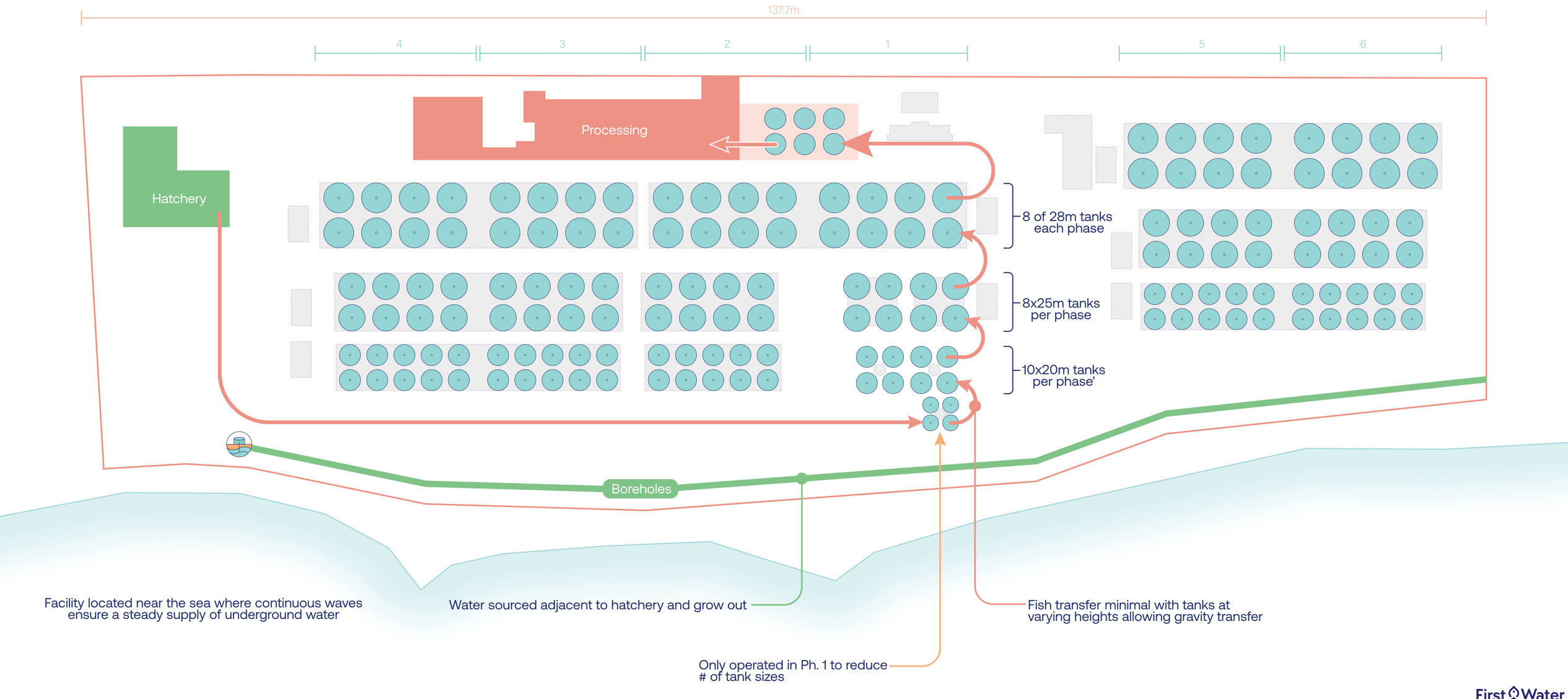
The grow-out in Laxabraut is a flow through with re-use. Our seawater is truly unique, and we source it from underground wells of seawater that has been naturally filtered through layers of lava delivering pure seawater of the highest quality.
The HQ is in Urðarhvarf 8B in Kópavogur only 35 minutes drive to Laxabraut.
Our farming practices are free from antibiotics, chemicals, and medicinal delousing treatments.
Our method imitates the natural life cycle of the Atlantic salmon that has spawned in our pristine freshwater, made the journey to the ocean. By being able to raise the salmon in constant environment with less stress growth is even during the life cycle giving the salmon firm texture and great taste.

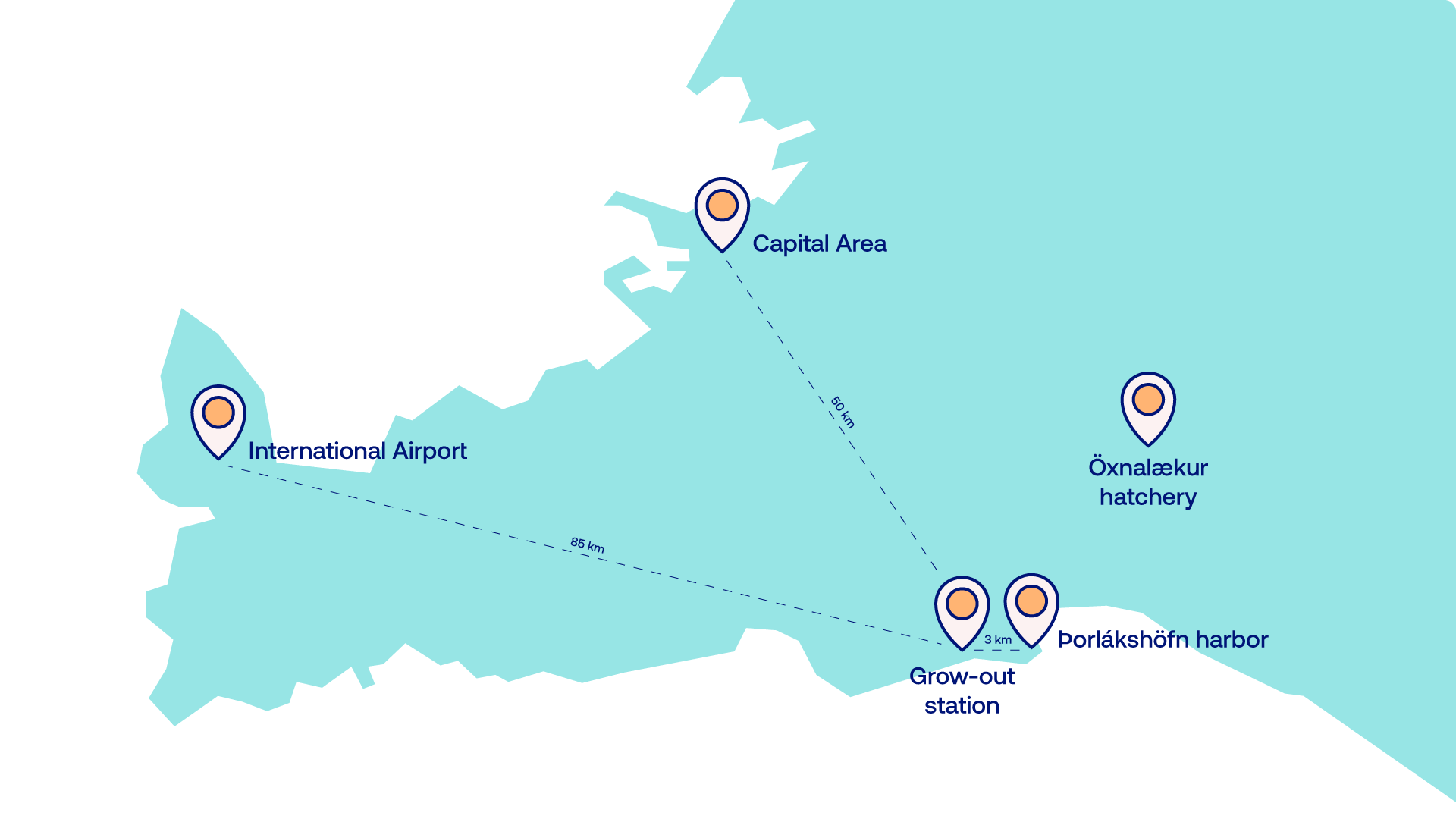
Built in southwest-Iceland, the main facilities at Laxabraut are being built close to Þorlákshöfn which has a well-situated international port that enables fast and direct access to First Water’s major markets in Europe. In addition, the grow-out facility is within 50 km to the Capital area where First Water has access to the east USA market.
The grow-out facility is only 85 km from the international airport in Iceland.
The grow-out facilities' proximity to the capital area of Iceland facilitates access to employees and increases the company’s competitiveness.
Saving 2-3 days in sea transport time to USA compared to Norway, where appr. 60% of the supply of Atlantic Salmon is originated.
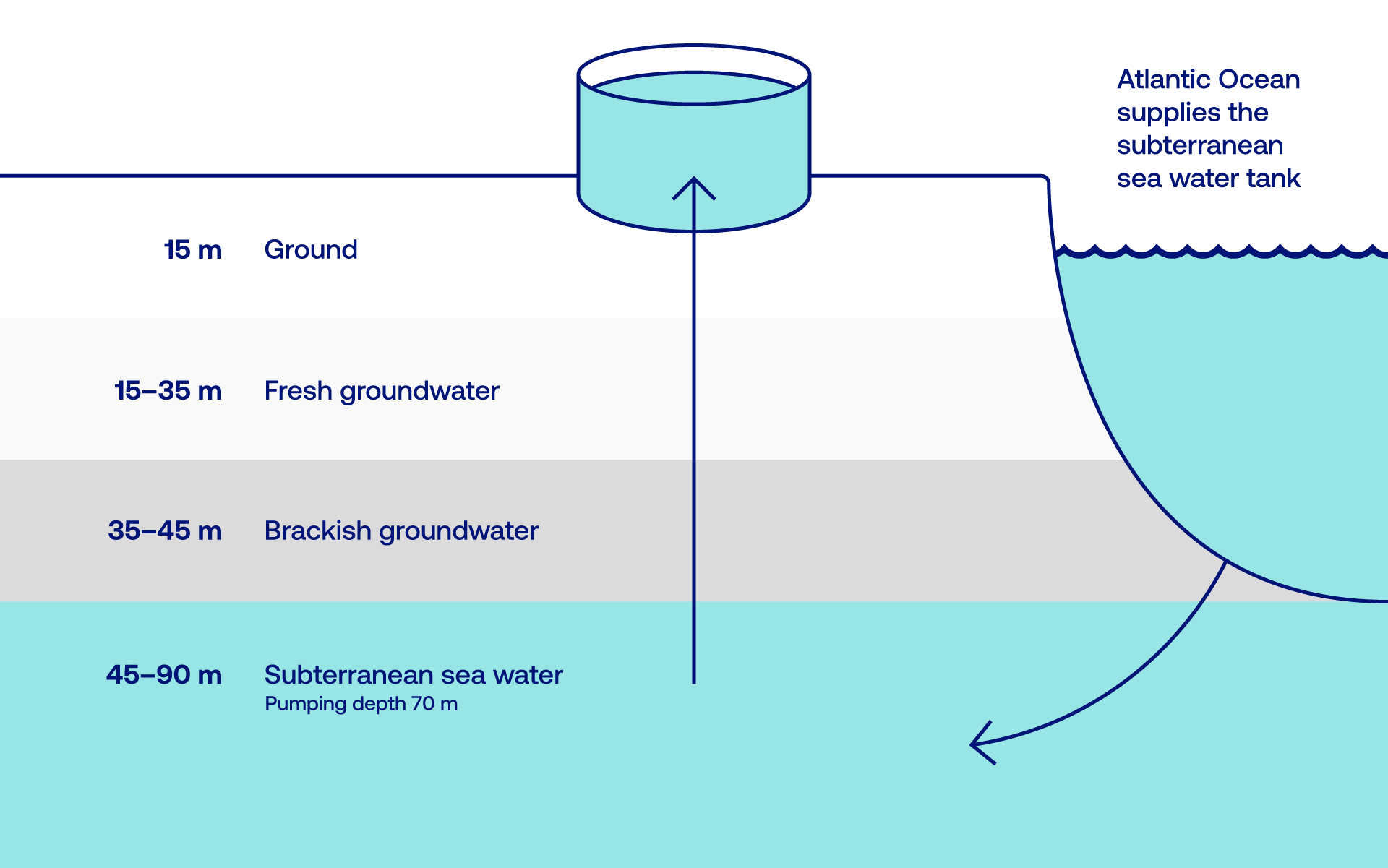
First Water’s plot is situated on a 5,000 to 10,000 years old lava field and at the edge of the volcanic belt which runs through Iceland.
The flowing lava meets the ocean, creating a unique porous lava bed where only a few locations with similar conditions can be found in Iceland and elsewhere in the world.
Long history of sourcing seawater through boreholes in the area. Already over 60 boreholes drilled over the last 50 years.
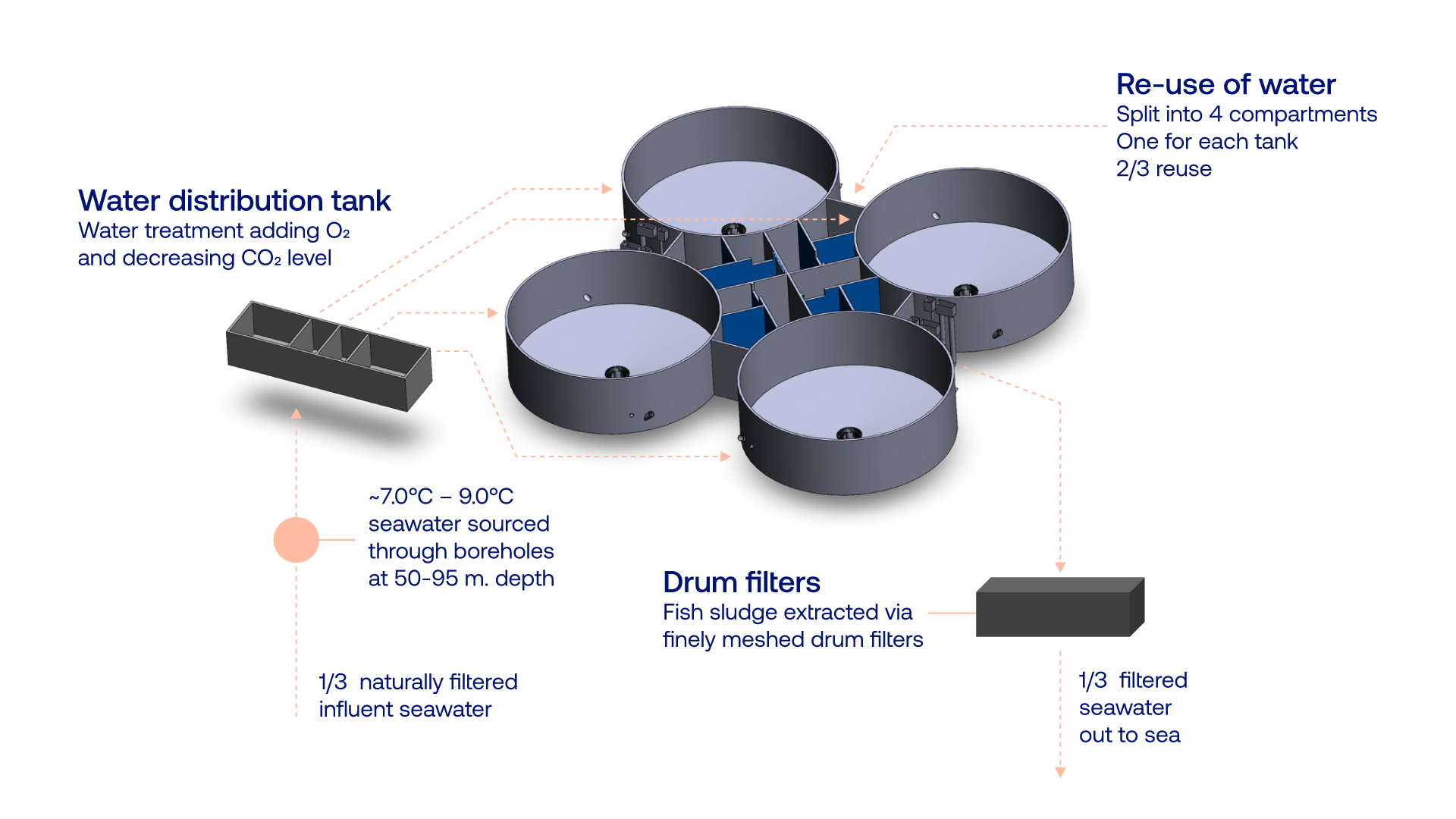
In land-based salmon farming, there are several different production methods being used. First Water is using the flow-through with re-use (FTS-R) production method.
First Water re-uses approximately 2/3 of the water in the tanks instead of using a full flow-through production method (no re-use). To re-use the water and keep optimal water quality, the water is treated before being pumped into the tank. This treatment of the water includes:
The seawater is re-used up to the limit where biofiltration is required, which is around 2/3 of the total seawater being re-used (1/3 new water). When biofiltration is used, called RAS production method, the production process becomes significantly more complex and CAPEX expensive.
Although the re-use production method needs significantly less influent seawater than the full flow-through production method, the volume of influent seawater is still significant or ca. 8,000 l/s for each phase. To be able to utilize the re-use production method, access to a vast amount of quality seawater is essential.
By re-using the seawater, First Water decreases the pumping volume of influent seawater by 2/3, which has a significant positive effect on both CAPEX and OPEX cost due to fewer boreholes needed and less energy usage.
Decreasing the amount of influent seawater is critical: